
Newsletter
Newsletter
Nieman Lab’s 2026 predictions argue that publishers are moving away from the factory model and toward resilience: niche-led products, owned distribution and deeper loyalty habits.
7th January 2026
With 2026 now underway, it feels like the right moment to step back and look at what industry-watchers think comes next, starting with Nieman Lab’s annual predictions for the year ahead.
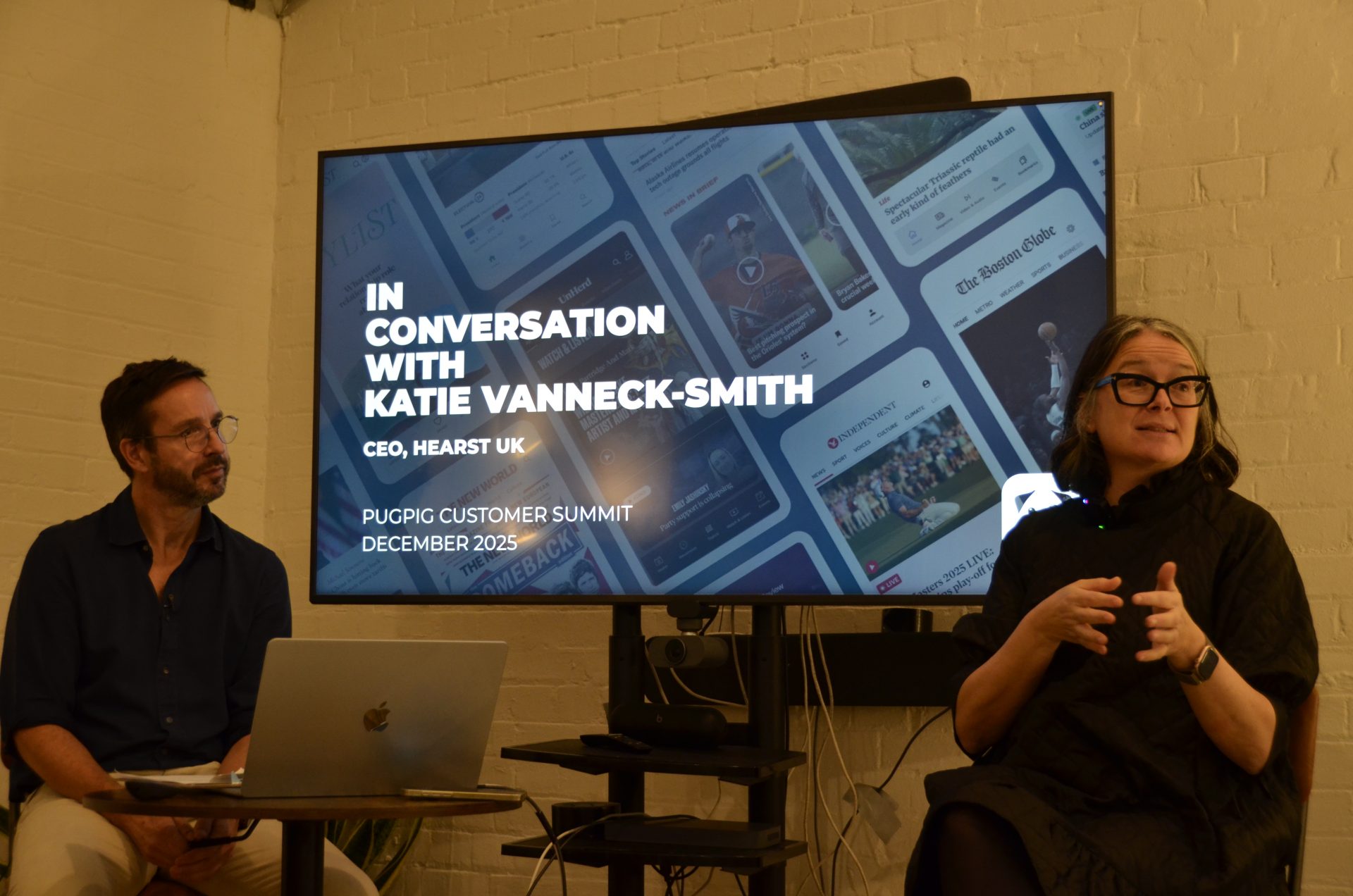
If 2024 and 2025 were defined by coping with platform volatility, from the continued erosion of social referrals to an increasingly unpredictable search landscape, then 2026 looks set to be the year publishers focus on rebuilding for resilience. A theme that David Buttle discussed in detail during our recent Pugpig Customer Summit.
The loudest signal across this year’s predictions is a pivot away from industrial-scale, volume-first journalism and toward products that are more useful, more distinctive and more human. That aligns strongly with what we’ve been hearing in conversations with publishers: “scale at all costs” is no longer the winning playbook. Loyalty, habit and direct relationships are.
For decades, publishers have taken a “department store” model where they compile every piece of content into a single magazine, newspaper, website or app. This approach relies on the users finding something they like, but if the predictions are to come true, 2026 will mark the end of that era.
Nieman’s predictors suggest a radical unbundling. Media Voices’ Chris Sutcliffe believes that we are entering the era of the “Ice Cream Shop” where publishers will need to focus on “how many flavors you’re able to sell, based on how many user problems you have found to solve”. Chris suggests that “Niche-based need is your friend, and growth comes from serving one niche well, then adding another, and then another”.
This is reinforced by one of the Niema Lab list’s more provocative ideas: The rise of the “throwaway” news app. The point isn’t that apps are becoming unimportant, but that some products could be designed to be time-bound, built for a specific moment, audience need, or event and then retired or folded back into the core experience. Instead of forcing a user who only cares about the World Cup or the General Election to download the main app, publishers might spin up lightweight, purpose-built experiences that exist for a moment in time and then vanish, or merge back into the main bundle.
In our Media App Report we found that app users are publishers’ most loyal segment, generating 3x the engagement of mobile web users. But “loyalty” is becoming specific. Users are loyal to topics, not just brands.
This shift demands a more flexible product architecture. It’s why we’re exploring how we can open up the Pugpig platform to publishers and serve on-device AI for privacy-centric personalisation. If a user opens your app, they might not want to see a generic feed, they could instead see a view that adapts to their “ice cream” preference.
If the product itself is changing, so is the content inside it. The “creator economy” is no longer an external threat, it is becoming the internal operating model for many newsrooms.
Julia Munslow, senior editor for social at The Wall Street Journal, predicts that creator journalists, not brands, will get invited to the party. Audiences, especially Gen Z and Alpha, tend to build trust with humans, not mastheads. Julia points out that when Dave Jorgenson left The Washington Post to launch LNI Media, the Post’s YouTube saw a massive drop in views.
As Julia highlights, audiences in the future are likely to build deeper trust with personalities rather than brands. Social platforms have led with this approach and if publishers are to close this gap, Julia suggests that they should focus on supporting journalists build personal followings. However, as Liz Kelly Nelson, founder of community and training platform, Project C points out, “creator journalism [needs to] develop sustainably” or if it’ll fall into the “exploitative dynamics of the broader influencer economy”.
If publishers are to invest in creator journalism, they will need modern formats to ensure that they are able to generate engagement on their owned platforms. Tristan Werkmeister, Reuters’ first social media video reporter, predicts that vertical video will be key to this. The goal is to bring the sticky, authentic feel of social media inside of the publisher’s app, often by reusing much of the content that is already produced for social media.
What this means is that your app needs to become a home for personalities as well as new content formats. You could consider if:
If the answer is no, you are leaving the door open for platforms to steal your talent’s relationship with the audience.
2024 was the year we panicked about ChatGPT writing news. 2025 was the year we experimented. 2026, according to Daniel Trielli, assistant professor of media and democracy at the University of Maryland, is the year of Agentic Journalism.
This is a topic we covered after attending INMA’s Media Innovation Week in Dublin and in his 2026 prediction, Daniel Trielli argues that the industry must prepare for a shift where readers will increasingly rely on these agents to find, filter, and summarise information. Trielli warns that newsrooms must consider how they monetise content, providing scaffolding in the form of structured data, clear citations and machine-readable context to prevent AI from hallucinating or misinterpreting facts. This new paradigm treats journalism as a database of verified truths to be queried by software, requiring a fundamental pivot from optimising for human engagement to optimising for algorithmic accuracy.
This idea connects to Ernest Kung’s prediction that big newsrooms will pave the way for AI agents. Ernest argues that AI “agents”, systems that can perceive a newsroom environment and take actions, not just generate text, are moving quickly from theory into practical newsroom workflows as new standards make it easier for tools to retrieve information, complete tasks and even coordinate with one another. He predicts that well‑resourced newsrooms will lead experimentation in 2026, but stresses that editorial use cases will require clear boundaries between tasks that must be deterministic and auditable and those where more flexible behaviour is acceptable, especially when multiple agents collaborate.
Finally, as digital content becomes infinite and cheap (thanks to AI), scarcity becomes valuable again. Multiple predictions point to a physical renaissance. Francis Zierer believes that “every media business becomes an events business”, suggesting that community can no longer just be a comments section. It has to be tangible.
Whether it’s journalism establishing a physical presence or local news touching grass, the strategy is to use digital to drive physical connection is clear.
For product teams, this means your app and website aren’t just content, they’re also a membership card. They’re the ticket to the event, the schedule for the conference and the tool for networking. The digital platforms become the bridge between the digital subscription and the physical benefit.
Reviewing these predictions reinforces the strategy we discussed all of last year. The “factory” model of churning out volume for search traffic is dead. The future is loyalty, personality and utility.
For us, there are four primary things for publishers to consider.
Don’t fear the “Unbundle”. Move away from the generic “department store” approach. Success lies in serving specific niches well. The “throwaway app” concept is extreme, and although we don’t believe it will take the exact form described, the logic is sound. Don’t be afraid to experiment with niche products, as The Independent’s Bulletin did recently. If you have a massive following for your local sports coverage, does that deserve its own dedicated experience rather than being buried in the main menu?
Invest in “creator” talent. Trust is shifting from mastheads to individuals. Publishers must build infrastructure to support journalists within their own platforms to prevent them from leaving for the creator economy.
Prepare for “Agentic Journalism”. The audience is no longer just humans, but AI agents acting on their behalf. Newsrooms should structure their data to be machine-readable, positioning themselves as verified knowledge providers that feed accurate information to AI models.
Leverage scarcity. As digital content becomes infinite and cheap, real-world connection becomes premium. Publishers should look to bridge the gap between digital subscriptions and physical events, facilitating networking and community.
Finally, one prediction stood out to us above all others: Loyalty, not scale, is key. For many publishers this will become the north star, if it isn’t already. The publishers who win in 2026 won’t be the ones with the most clicks, they’ll be the ones with the most habituated, trusting and engaged communities.
Here are some of the most important headlines about the business of news and publishing as well as strategies and tactics product, audience growth and newsroom strategy.
Newsletter

Newsletter
Newsletter
Newsletter