

Newsletter
Newsletter
Vertical video has evolved from a social-first experiment into a core publisher product, with publishers like The Economist using it inside owned apps to deliver deeper journalism, boost engagement and strengthen subscriber relationships.
18th March 2026
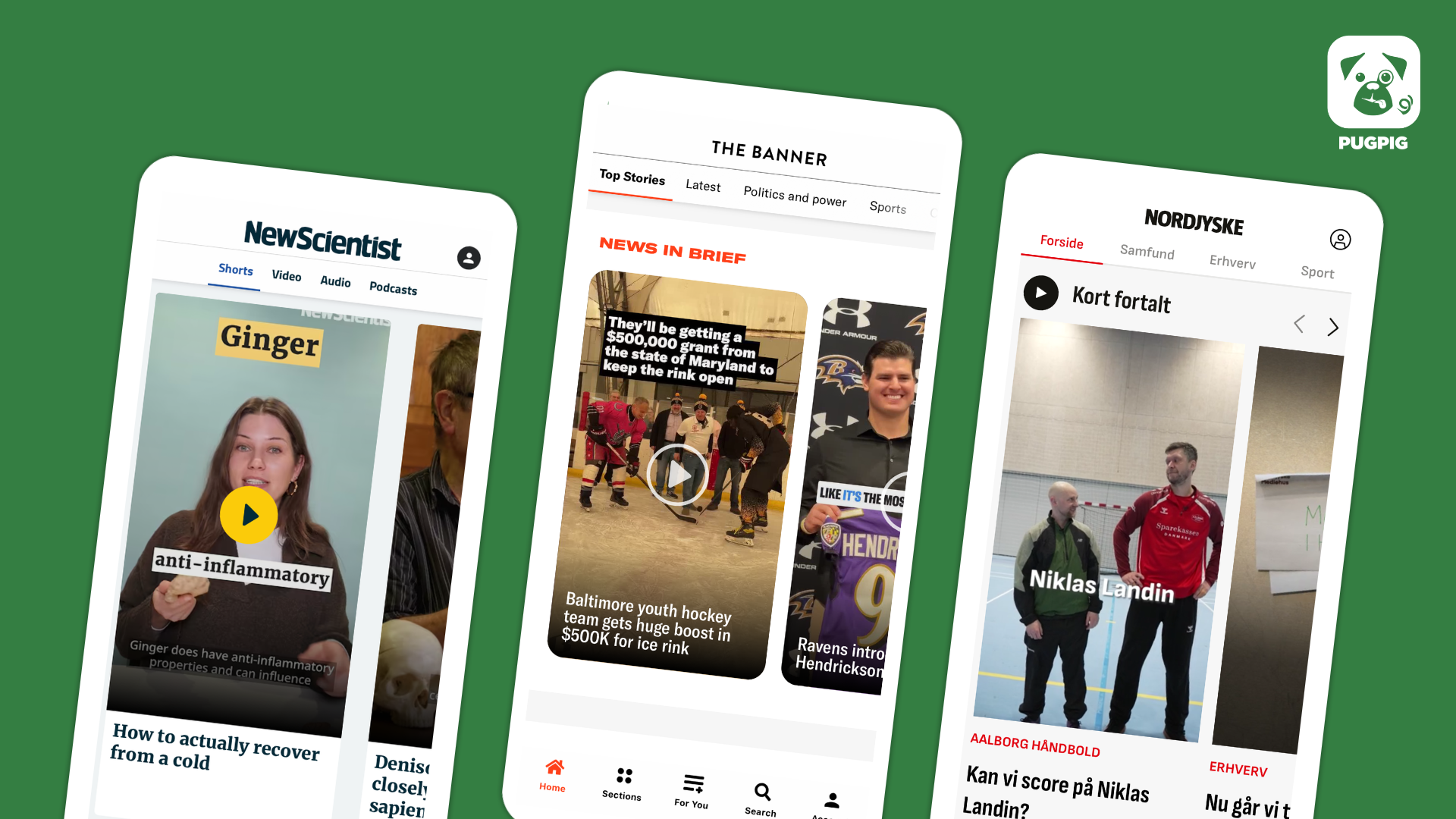
Back in December 2024 we wrote a media bulletin that looked at the shift publishers were starting to make towards vertical video. Back then, it was still an experiment for many, seen as a way to build an experience that connects younger audiences who are used to engaging with short-form video content like Instagram Reels, YouTube Shorts and TikToks. Largely, it was a nice‑to‑have in a news app for publishers that already produce the videos. Almost eighteen months on, vertical video has moved from side project to core format, with numerous publishers, like The BBC, The Economist and the New York Times (plus many others) making it increasingly prominent in their apps.
In today’s Pugpig Media Bulletin, we revisit the arguments we made in 2024, looking at what has changed since then and how publishers should be thinking about vertical video in their products today.
In late 2024, we saw that the majority of publishers were taking a social-media-first approach to vertical video. In an attempt to reach younger audiences, they were meeting them on the platforms where they were most active – TikTok, Instagram and YouTube. Once they’d developed content for those sites, they replicated that experience in their own apps. We highlighted how publishers used vertical video to navigate a platform reset, as younger audiences shifted away from Facebook and Twitter towards video‑led networks. They believed that app experiences that are borrowed from social feeds could feel more intuitive for younger users.
Large events such as the Olympics gave publishers the perfect test bed, with some seeing positive growth in engagement when they leaned into video‑first formats. The underlying bet was that vertical video could be a bridge which meets younger users on social platforms, then pulls them towards owned products where publishers have more control over experience and monetisation.
Since then, two big shifts have made vertical video feel much less optional.
First, social and video networks have continued to cement their position as the primary way younger audiences access news. In the summer of last year, The Reuters Institute’s Digital News Report showed that across 48 markets, the share of people consuming news via social video has risen from 52% in 2020 to 65% in 2025, while overall news video usage has climbed from 67% to 75%. In the US, over half of 18-34‑year‑olds now say social media and video networks are their main source of news, with traditional news sites and TV continuing to lose ground.
Second, there is an indication that short‑form vertical video might be escaping the confines of the big platforms and becoming table stakes for news consumption. Research commissioned by Media.net in late 2025 found that 90% of US consumers are open to seeing short‑form video on publisher platforms and that 73% watch short‑form video multiple times per day, mainly on mobile devices. Complementary work by AdPlayer shows that more than 70% of US consumers now watch short‑form video daily and more than 60% find it more compelling than conventional articles, particularly for longer or more complex topics.
Put simply, vertical video is no longer a TikTok‑only behaviour. Audiences expect it wherever they consume news and features, which creates both a threat, because attention is moving faster than many products, but also a significant opportunity for publishers who bring vertical video into their own environments.
Against this backdrop, The Economist’s approach to vertical video demonstrates a shift in approach. Speaking at INMA’s Young Audiences Initiative, Liv Moloney, head of video at The Economist, argued that vertical video is now non‑negotiable if you want to reach younger audiences. “Vertical video is here to stay… if you want to reach younger audiences, you simply have to create vertical video in order to be there.” The distinctive choice The Economist made was not whether to invest in vertical video, but how to do it.
But rather than simplifying stories into lightweight clips, they have deliberately leaned into dense, analytically rich videos that reflect the same tone, depth and worldview as their print journalism. They believe that density may beat the snackability of social media content.
Crucially, The Economist have enhanced the vertical video functionality of their app, giving paying users a swipeable, short‑form viewing environment that sits alongside articles, audio and newsletters, all governed by the same editorial standards and subscription-first focus. And they’ve been very successful, with previous Nieman Lab’s analysis of publisher adoption, showing that after adding in a dedicated video tab, The Economist more than doubled paid subscribers’ engagement with the medium.
This marks a clear evolution from the 2024 mindset. Vertical video is now part of the core product, not just a top‑of‑funnel marketing channel. With that, it can carry dense, premium journalism without diluting the brand and can be used as a tool for subscriber value and retention, not only for reach
Over the past year, we have also gathered data from publishers experimenting with vertical video inside their Pugpig apps. The picture is still emerging, but the first signals are encouraging.
We found that whilst vertical video accounted for a relatively modest share of overall app consumption, users who did watch vertical clips were significantly more engaged than the average app user. For one publisher, engagement with vertical video was around 64% higher than the baseline for other in‑app video, and these vertical viewers were more likely to return to the app and explore formats such as articles and audio.
We also saw that vertical video works best where publishers already have an active short‑form video operation and can extend it into the app, rather than trying to build video capabilities from scratch. Teams that treat vertical as another habit‑building touchpoint, alongside puzzles, newsletters and audio, tend to find more sustainable use cases than those chasing raw view counts. And in several cases, tools that transform existing assets like photo galleries or explainers into quick vertical clips helped lower the barrier to entry for publishers without large video teams.
To further enhance the options available to publishers, we’ll soon be rolling out Bolt Clips, a dedicated vertical video tab with TikTok-style swipe-to-advance behaviour, giving audiences a familiar, mobile‑first way to move through videos. If you’re interested in experimenting with this next generation of vertical video inside your app, get in touch with the Pugpig team and we’ll work with you to get everything set up
If you were starting from scratch today, the first question would be what job you want vertical video to do. For some brands, it is primarily about reach and relevance with younger audiences who see vertical as their default language for news and entertainment. For others, the priority is deepening engagement among existing users by giving them a lightweight, mobile‑friendly way into journalism when reading a long article is not practical.
Once the aim has been defined, choices about social vs owned environments, brief vs dense treatments and free vs subscriber‑only content become much clearer.
There is also a growing recognition that social and owned vertical video should feel different, even if the voice is consistent. In 2024 we talked about lifting social formats into apps, but The Economist’s experience suggests a sharper split. On TikTok, Reels and Shorts, you still need strong hooks and brisk pacing, working on the assumption most viewers are not yet subscribers. Inside their own apps and sites, publishers have more room for depth, series and recurring strands, with vertical video acting as an on‑ramp to richer explainers, podcasts and interactive features.
Since 2024, the way publishers structure vertical video in their products has changed just as much as the content itself.
We are now seeing dedicated vertical “watch” tabs in news apps, using swipe‑to‑advance behaviour and personalised queues that feel familiar from social feeds, offered as part of the core subscriber experience rather than a separate lab or spin‑off. At the same time, short‑form vertical modules are appearing on home screens and article pages, surfacing relevant clips alongside longer investigations or inside live news hubs.
For Pugpig customers, the practical question is where vertical fits within existing Bolt layouts and navigation, whether that is a dedicated tab, a home‑screen carousel or a mix. The right answer depends on video volume, audience behaviour and whether the publisher is primarily optimising for reach, engagement or subscription and registration.
What matters most is that vertical video has a defined place in the product, rather than being scattered as one‑off experiments that users rarely encounter.
The Economist case study underlines what many users actually want from vertical video. They are not necessarily asking for less journalism, they are asking for content delivered in ways that fit their habits and attention patterns.
This may mean treating vertical video as another format for delivering distinctive, high‑quality journalism. At News in the Digital Age in London last month, one of the clearest messages was that publishers will only thrive in an AI‑shaped media landscape if they double down on what makes their coverage unique. The same principle applies here – a vertical video strategy built purely around copying social platforms, or relying too heavily on AI to generate content, is unlikely to deliver more than limited gains.
Instead, vertical video works best when it extends and enriches journalism that is already engaging audiences. Two weeks ago, we wrote about how text‑to‑speech enables publishers to repurpose article content into a format that reaches audiences at moments when reading is less practical. We think vertical video should be approached in much the same way. Its real value lies in being structured and presented in a way that complements existing content, opening up new entry points without diluting what makes that content valuable. As Liv Moloney put it, The Economist aims to add value at the margin rather than telling audiences what they already know, a mindset that works just as well in vertical video as it does in long‑form journalism.
When we first wrote about vertical video, our goal was to explore if it could help publishers reach younger audiences. A year and a half later, the questions publishers are wrestling with are more ambitious. The Economist has demonstrated that you can take a 180‑year‑old brand and use vertical video to deliver dense, intellectually demanding journalism in formats audiences are increasingly choosing to watch, inside a subscriber product. Our own data from Pugpig apps suggests that, when vertical video is integrated, the users who engage with it are among your most valuable and most frequent visitors.
The challenge now is to move beyond repurposing social vertical video content to answering more precise questions, such as where exactly vertical video sits in the product, what job it’s designed to do and how it deepens relationships rather than simply adding more content in already crowded feeds.
Here are some of the most important headlines about the business of news and publishing as well as strategies and tactics product, audience growth and newsroom strategy.
Newsletter

Newsletter

Newsletter

Newsletter