
Newsletter
Newsletter
Publisher apps are no longer just for retention. With in-app revenue rising and engagement at its highest, they’re becoming powerful acquisition channels. We break down how publishers are moving apps up the funneland what it takes to convert engaged readers into paying subscribers.
1st April 2026
For years, publisher apps have been the delivery mechanism. Someone buys a subscription, then downloads the app to consume content. Apps existed to serve subscribers and keep them renewing. Now, publishers are waking up to what the data has been saying for a while; apps aren’t just where subscribers go to read, they’re where subscribers come from. SensorTower’s numbers back this up – global in-app purchase revenue is up 10.6% year-on-year, and readers are spending more time on mobile than ever. The window is open to turn those high-engagement app audiences into paying customers.
In today’s Pugpig Media Bulletin, we’re looking at how apps are moving up the conversion funnel, from retention tools to acquisition channels.
We’ve said many times that apps are where your most loyal readers live. Digital Content Next’s 2025 analysis puts it well – apps now give publishers “a central role in building strong, lasting relationships with readers.” These are the environments subscribers use most often and for the longest sessions. Our own benchmarks showed app retention dramatically outperforming the broader app market, with app users far more likely to still be active after 30 days than typical news site visitors
This isn’t just a publisher story. The entire app economy is shifting toward subscriptions. Sensor Tower’s State of Mobile data shows global in-app purchase revenue up more than 10% year-on-year. Crucially for publishers, non-gaming apps have driven most of that growth. By 2025, non-game apps slightly surpassed games in in-app revenue, hitting about $85.6 billion and growing significantly faster.
Subscription-analytics specialists see the same trend. Adapty’s 2025 State of in‑app subscriptions report notes that while installs are flattening, in-app purchase revenue keeps climbing. Weekly subscriptions now make up nearly half of all subscription plans. RevenueCat’s State of Subscription Apps 2025 emphasises that subscription apps remain a powerful growth area (though increasingly competitive), with success depending on optimising the full journey from download to retention.
Why does this matter? Because users are now comfortable starting and managing subscriptions inside apps, not just on the open web. And news and magazines sit right in the middle of the path of future subscription growth.
The subscription market for news is getting tougher. The Reuters Institute Digital News Report 2025 found that across 20 wealthier countries (including the US and UK), only about 18% of people pay for online news. That figure is basically flat year-on-year, and the pool of “likely payers” is already tapped out.
Publishers need new levers. Our 2025 Media App Report showed that many are already using apps to acquire subscribers directly – through in-app subscriptions, premium membership tiers or voucher-based access that converts users into paying customers. Stylist’s VIP membership launch is a good example – they created a dedicated premium space in the app, turning it into the front door for paid products, not just the reading room.
Digital Content Next makes a similar argument. As platform referrals crumble, publishers are “betting big on apps” as the place where they control the experience, own the data and monetisation and run sophisticated subscription strategies. This matches what we’re hearing from Pugpig customers – your most loyal readers are in your app, app-store economics are solid and the opportunity is to turn that engagement into revenue.
Converting engaged non-subscribers into paying app users is still hard. Many apps have large audiences of non-subscribers with mixed engagement levels. The challenge is building loyalty while identifying the right moment to ask for payment. This is driving interest from publishers we speak to in dynamic paywalls and multi-stage journeys that respond differently to casual browsers, loyal readers and users showing real conversion intent.
Another problem is that web subscription funnels are usually more mature and better-tested. App paywalls have historically been rigid and harder to optimise. App-store payment flows also introduce friction or commercial trade-offs (hello, 30% cut), which is why teams are asking us about ways to bring more experimentation into app conversion.
Timing and sequencing matter more than ever. Publishers aren’t just thinking about what a paywall should say, but who should see it, after what behavior and whether registration should happen before subscription. At the same time, reducing friction in the purchase journey is critical – too many steps or unclear messaging kills conversions, even when the offer itself is strong.
Underneath all this is a shift toward tailored conversion journeys. Instead of one static paywall for everyone, teams want to differentiate by login status, engagement level, acquisition source and content interests. Apps are now getting the same treatment as web – testing triggers, refining journeys, improving measurement so that understanding can be built.
When you translate these needs into product requirements, three areas stand out:
1. Paywall flexibility and targeting
Publishers need control over how paywalls behave for different audiences. That means showing different states to anonymous users, registered users and lapsed subscribers, plus granular control over which content types trigger a paywall.
2. Friction-free purchase flows
The subscription journey needs to be seamless. For publishers using External Link Entitlement to sell outside the app stores, that means connecting the user journey from app to web. For those selling directly through the stores (the majority), it’s about improving how users link their app-store subscriptions to the publisher’s backend. The goal is to reduce unnecessary steps and build a subscription funnel that not only converts, but allows for publishers to own the relationship with the subscriber.
3. Analytics and optimisation
Teams want reliable tracking of paywall events and states, better visibility into which content and screens most often lead to subscription and deeper insight into conversion funnels. The thread running through all of this – control who sees what and when, reduce friction at key conversion moments and measure performance well enough to keep improving it.
This directly shapes our roadmap.
The sophisticated subscription funnels, A/B tests and pricing experiments have traditionally lived on the web. Now that publishers recognise their most engaged readers are in the app and that app-store subscriptions are mainstream, the focus shifts to giving apps the same level of sophistication. The opportunity is showing the right message to the right person at the right time.
Static paywalls can still be effective, but there is a growing view that they could be made more responsive to user behaviour. A first-time anonymous visitor and a daily reader who’s opened the app for three months straight shouldn’t see the same prompt at the same moment.
Dynamic paywalls are our answer. We’re building tools that give publishers meaningful control over when a paywall appears, often powered by external decision engines and AI-driven models. Those decisions can be based on user state (anonymous, registered, lapsed subscriber), content type, engagement level or other contextual signals. Each time a user interacts with content, we send that context to your decision logic. If it says “let them read,” they continue seamlessly. If it says “show a wall,” we present a paywall with messaging tailored to that user and moment.
Registration walls are key here too. Capturing an email before asking for payment is a fundamentally different strategy than a hard paywall. You need to be able to run both, compare them and measure properly.
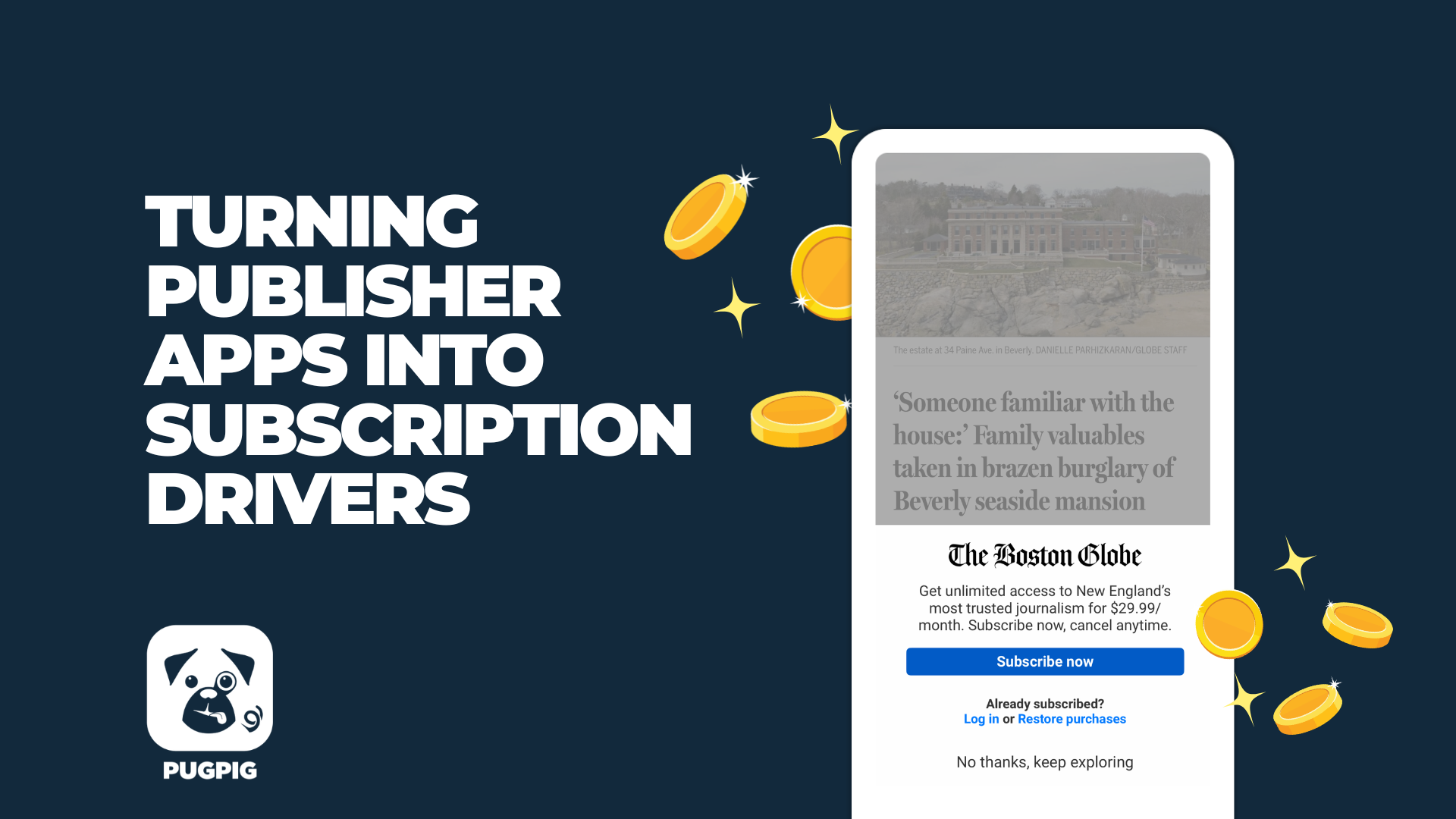
Our redesigned subscription modal is the other piece. Even the best-timed, best-targeted wall can fail if the purchase experience is clunky. That final moment – when a user decides whether to subscribe – is won or lost in the UX.
That’s why we’re focusing on:
In practice, the two layers have to work together:
As the wider app economy becomes more subscription‑heavy and publishers increasingly treat apps as primary conversion channels, we’re building Pugpig so that your apps aren’t just the best place to consume journalism, but an essential component in the subscription journey.
Here are some of the most important headlines about the business of news and publishing as well as strategies and tactics product, audience growth and newsroom strategy.
Newsletter

Newsletter

Newsletter

Newsletter