

Newsletter
Newsletter
What we took from INMA Berlin: AI is the new plumbing, but the real value still lies in trusted brands and the small group of users who love them.
14th May 2026
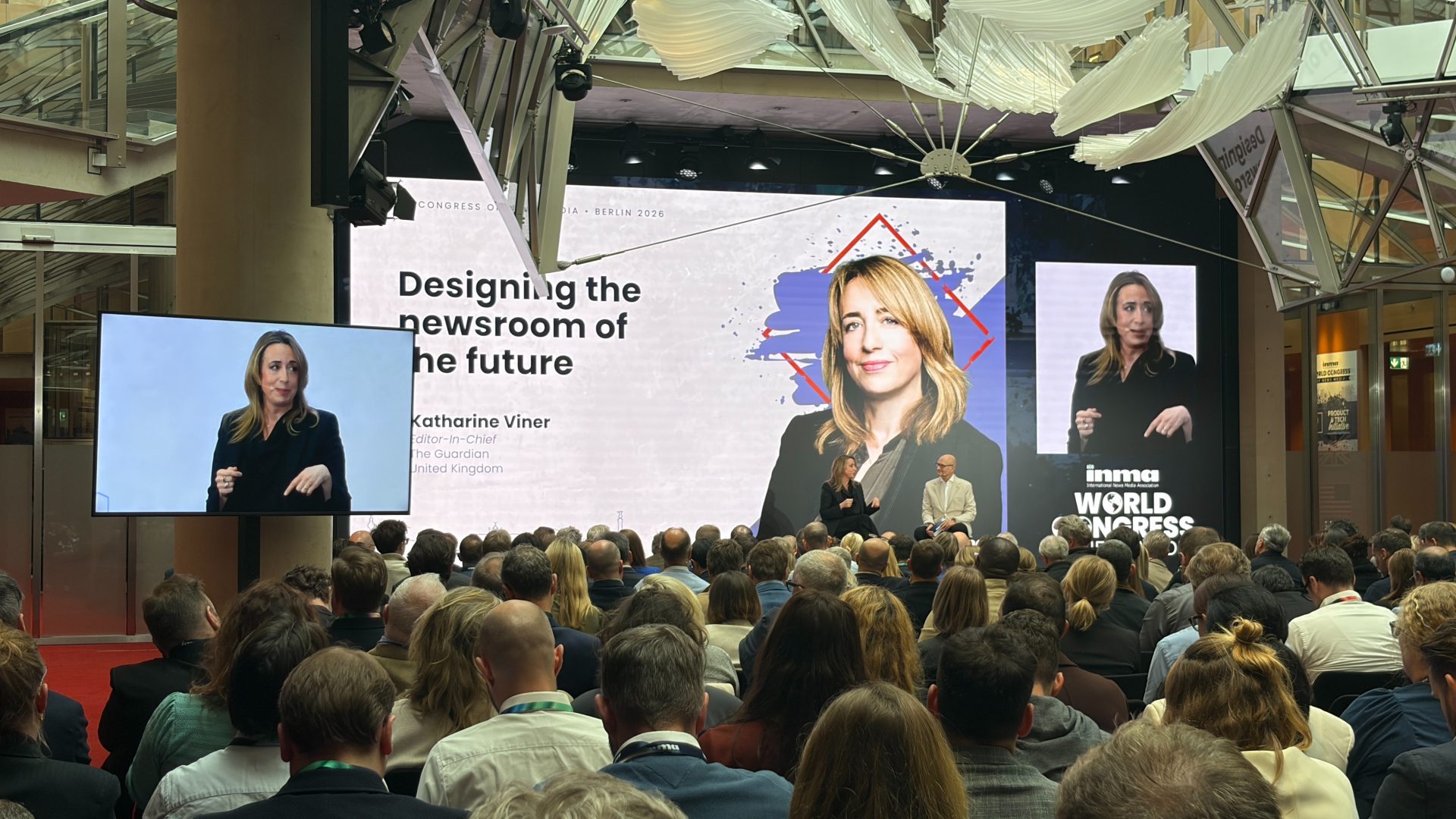
Last week, Pugpig’s CEO went to Berlin for the INMA World Congress of News Media. The topics, unsurprisingly, focused on how publishers are responding to AI and how shifting reader habits are putting pressure on the subscription funnel.
In this week’s Pugpig media bulletin, we’ll dig into what stood out. Specifically, why structured intelligence and IP protection are gaining momentum, how “super users” are reshaping subscription and ad strategies and what all of this means for the way you build and run your apps
Last week’s INMA World Congress in Berlin reinforced much of the recent commentary we’ve discussed in this newsletter. AI can no longer be something publishers bolt on, instead it is a long-term structural reset of how journalism is made, distributed and monetised, and of where value actually lives in the news ecosystem.
When Pugpig attended the INMA summit in Dublin in September, there was a considerable amount of anxiety around the role of AI, but in Berlin there was a shift from concern to action. The focus of the conference was in two parts. Firstly, there was an honest diagnosis of the threats of content scraping, synthetic information flooding every feed and search and social decaying as discovery engines. Secondly, it looked at how publishers could respond with concrete playbooks from publishers who are focusing on building trust, brand and super users, rather than chasing reach.
There was a strong consensus from the conference that content is now the third pillar of the AI supply chain, alongside chips and power. Verified human journalism, enriched with clean metadata, is the fuel that keeps large language models accurate. But historically, publishers have been giving that fuel away for free.
Speakers from organisations like the Associated Press and People Inc argued that the industry has to move from being “media providers” to “multi-industry data and insights authorities”, monetising facts as structured intelligence rather than just stories on a page. That means aggressively blocking unknown crawlers, cleaning up HTML-bloated pages into machine-readable text and building licensing frameworks that let AI systems pay at scale for the right to train on publishers’ material.
Whilst AI agents and systems are now essential components of the publishing industry, content created solely to serve AI engines is unlikely to be a sustainable path to success. Multiple speakers argued that, in a world flooded with synthetic content, publishers must make trust a core part of what differentiates their products.
Key to this is media companies developing their brands. As Earl Wilkinson said in his talk, winning publishers will be those that are “unmistakably themselves”, prepared to lose some casual readers in order to build deep loyalty with a clearly defined community. That was echoed by Funke’s Julia Becker, who described news organisations as democratic infrastructure who “do not produce steel, cars or any other goods”, but instead produce “something far more fragile and far more valuable… trust”.
This presents an opportunity for publishers, because truthful, accurate, journalism, delivered in highly engaging formats, like mobile apps, allow them to build a differentiated experience from that provided by the AI-search driven ecosystem.
One important concept that emerged from the conference was the “super user thesis”. Speakers from INMA’s Readers First initiative and publishers Clarin, News Corp Australia and Bonnier all landed on the conclusion that a tiny cohort of highly engaged users now drive a disproportionate share of both subscription and advertising value.
This is backed up by INMA data showing that, across 300 brands, roughly 1% of users generated 26% of all pageviews. That concentration of attention helps explain why highly engaged, logged-in users are often far more valuable commercially, driving stronger ad yield as well as subscription potential. Seen through an app lens, the implications are clear. App users are often among the most engaged cohorts in a publisher’s audience. That strengthens the case for investing in-app features such as push notifications, personalised content, puzzles, live blogs and audio.
To stay relevant to audiences despite these headwinds, publishers are rethinking how they create and distribute content. Interestingly, some of the most compelling innovation is happening at the smallest possible scale through local community reporting and creator-journalists, with AI increasingly used to help those models scale.
Markus Knall, Editor-in-Chief at Ippen, showed how the company’s network of regional titles used AI to produce 5,000 hyper-local articles in just five days during the German elections, generating more than a million page views. For Markus, this approach freed up resources to invest in newsroom marketing, while also serving as a strategic play with content so hyperlocal that big tech is unlikely to compete.
Meanwhile, Bild’s Paul Ronzheimer showed that a war correspondent can become a hugely valuable digital-era creator without sacrificing neutrality. His daily podcast reached millions of monthly streams, with strikingly high completion rates despite episode lengths of 40 to 45 minutes, all produced by a tiny team and amplified across multiple Axel Springer brands. Paul’s most valued feedback is “I have no clue who you’d vote for”, suggesting that deep analysis and a strong personal brand can coexist with editorial independence..
These case studies suggest that the sweet spot is a combination of high-volume, AI-supported local content that makes journalism useful in people’s everyday lives, combined with creator-led, trust-first formats.
Kerstin Hasse, Young Audiences Initiative Lead at INMA, argued that younger readers “don’t hate the news. They might just hate your formats”. Platforms like TikTok and Instagram are where they expect to encounter information, but they respond to native storytelling rather than lightly repackaged print journalism. One of the more interesting solutions proposed in Berlin was “liquid content”, defined as stories designed to move fluidly across formats, platforms and moments of use.
The term “liquid content” was originally coined by executives at Finland’s public broadcaster, Yle, and the organisation has continued to develop the idea. At the event, Yle explained how it has spent a decade moving beyond topic-based personalisation towards a model in which the same story can fluidly become audio, text or video, depending on what best suits each person’s context at that moment.
Mika Rahkonen, head of strategy at Yle, explained that they think beyond static articles to treat stories as flexible assets that can be read, watched or listened to in whatever format suits each person’s current context. Using signals like time of day, location and past behaviour, the same underlying journalism is reshaped into audio, text or video and pushed at just the right moment, putting the consumer “in the driver’s seat” while making personalisation a strategic necessity rather than a nice-to-have.
For publishers looking to develop content to allow them to appeal to younger audiences then taking a liquid approach is a scalable way of doing that. It requires thinking in micro elements such as clips, article summaries, audio segments and interactive elements that can be assembled into different experiences inside different products. That’s also the logic behind some of the work we’ve been doing at Pugpig, from dynamic audio playlists and a clips-style video player to user-defined personalisation with Bolt Follow.
INMA Berlin also underlined that to deliver these editorial transformations, organisational changes will be needed too. Almost every successful case study involved changes to structure, decision rights and hiring.
On the governance side, The Guardian’s editor-in-chief, Katharine Viner, described an “editor-first” operating model in which the editor sits slightly ahead of the CEO, with the Scott Trust guaranteeing long-term independence so commercial decisions remain aligned with mission. The New York Times was cited for embedding a marketing function of around 100 people directly in the newsroom, turning conversion and habit formation into a joint editorial–commercial responsibility instead of a distant growth team’s job.
To deliver this, several speakers argued that AI literacy now needs to be a baseline hiring criterion alongside a redefinition of newsroom roles to empower journalist-creators and to allow AI to simplify some of the news gathering process.
Throughout the conference it was clear that there are no simple quick fixes to the challenges of AI but publishers making the most progress are doing it by looking at building trust, developing super users and leveraging AI to develop liquid content that can be multi-platform. If you’re keen to compare notes on how others are translating these themes into app, audio and push strategies, we’d love to continue the conversation.
Here are some of the most important headlines about the business of news and publishing as well as strategies and tactics product, audience growth and newsroom strategy.
Newsletter

Newsletter

Newsletter

Newsletter

Newsletter