

Newsletter
Newsletter
From Sulzberger’s call for publishers to stand together against AI platforms to new thinking on video, reader revenue and AI-native workflows, Marseille made one thing clear. The future of publishing will be shaped by trust, direct relationships and smarter products.
11th June 2026
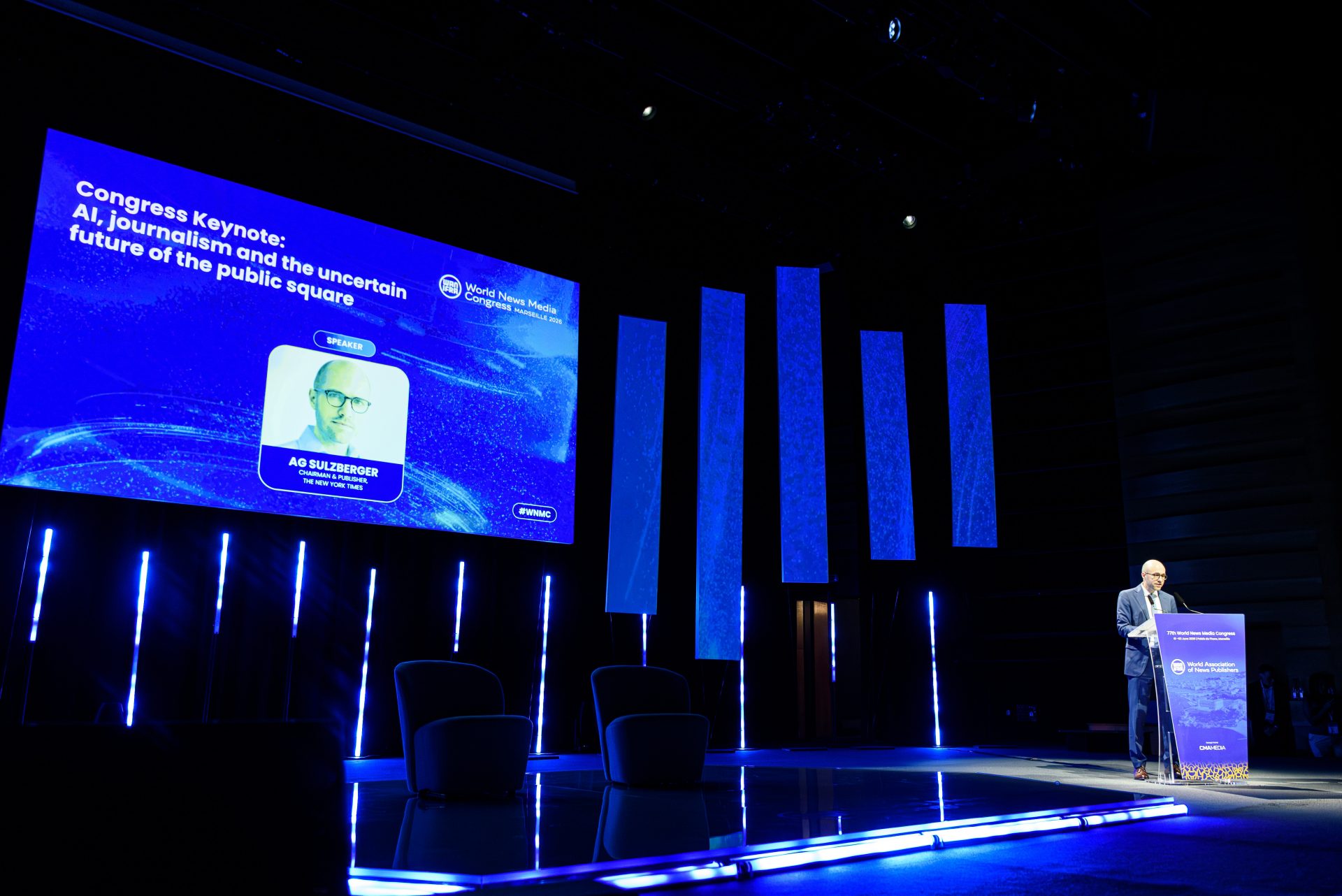
Last week’s WAN-IFRA World News Media Congress brought the global news industry (along with Pugpig!) to Marseille for three days of debate on AI, journalism and sustainable growth. The congress was built around three core themes, AI in media, the future of journalism and revenue & growth, but across the event those strands repeatedly came together.
This edition of the Pugpig Media Bulletin looks at the main takeaways from the discussions in Marseille and considers what it all means for publishers.
If there was a single moment that crystallised the tension between publishers and AI platforms in Marseille it was the opening keynote by A.G. Sulzberger, publisher of the New York Times. In it, Sulzberger condemned AI giants for “brazen theft of intellectual property” and accused them of “strip‑mining” news sites and “hijacking the public square” at unprecedented scale. Sulzberger stressed that whilst AI needs talent, compute, energy and data to be successful, companies are willing to only pay for the first three and that “AI companies take ‘data’ without consent or compensation.”
Sulzberger contrasted this with earlier digital disruptions, where there was at least a slightly skewed value exchange. He noted that getting a Google user to click a news link is now “10 times harder” than a decade ago and he cited a study that suggested AI search products send referral traffic at a rate 96% lower than Google Search. The message to publishers was a call to arms. Stand up for your rights, be far more careful about deals, push legislators on IP and scraping and work together rather than negotiating alone.
While concerns about how AI companies are using publishers’ content were a recurring theme, much of the discussion focused on how news organisations can apply AI within their own workflows. One example came from USA Today, where Jessica Davis argued that the traditional human-in-the-loop approach does not scale. Instead, her team made faster progress once they built an evaluation framework around clear definitions of success, which ultimately helped them develop an AI agent to handle public records requests.
Not long ago, many publishers were still in the early stages of experimenting with AI. From the conversations at WAN-IFRA, that phase now appears to be over. AI is moving into mainstream use and the focus is shifting towards the governance frameworks needed to use it responsibly and effectively. Prisa Media offered one clear example of the risks of the shift, describing how evidence of widespread staff use of AI tools with sensitive information, along with a high error rate in AI-generated answers, prompted the company to pause further rollouts, put stronger oversight in place and create a shared internal AI resource.
But the conversation in Marseille was not only about how publishers use AI. It was also about what journalism needs to offer in a media environment increasingly shaped by synthetic content, platform disruption and changing audience habits. In a fireside chat, Guardian editor-in-chief Katharine Viner described the past decade as one of “absolute turmoil” and said journalists should think of themselves as citizens embedded in the communities they cover, not separate from them.
Drawing on Naomi Alderman’s idea of a “third big information crisis”, Katharine argued that audiences are now living through a flood of information and misinformation, with “the majority now of what is online” being synthetic. In that environment, she said, trusted news organisations become even more important, and anything that helps a newsroom distinguish itself from the surrounding “splurge of fake information” is worth backing. She also pushed back on easy narratives about news avoidance, arguing that Guardian data points less to disengagement from news itself than to changing audience expectations around format and fit.
The New York Times’ Solana Pyne picked up that thread from a visual angle. In a talk where she explained the NYT’s approach to video, Solana noted that while surveys say most people prefer to read news, around three‑quarters of Americans now watch news videos weekly. For the Times, the response has been to build a video operation focused on stories that “must be watched”, backed by specialised teams and a dedicated “Watch” tab in the app that mimics the swipeable, vertical video feeds people know from social platforms. The goal is to leverage what is known to work on platforms like Instagram and TikTok within a curated, distinctive video experience on Times‑owned surfaces, which can be monetised directly through subscriptions and advertising.
Many of the same pressures shaping journalism strategy also surfaced in the congress’s revenue and growth conversations. Katharine Viner’s session doubled as a reader-revenue case study, with the Guardian showing how its contribution model has become central to the business. Katharine pointed out that 83% of its revenue outside the UK did not exist a decade ago and although initially their reader contribution model was “utterly ridiculed”, it is now foundational to the business. She argued that it works because supporters see themselves as part of a community rather than simply consumers, making contributions feel more resilient than a traditional paywall model.
On the strategy front, the Innovation in Media report unveiled in Marseille showed that AI has made content effectively limitless while leaving distribution increasingly fragile. In that environment, value is shifting towards trust, proprietary data and direct audience relationships. Its editors, Juan Señor and Jayant Sriram, say that publishers who treat AI only as an efficiency tool risk producing “vanilla content”, while those that use it as a growth engine can unlock new products, markets and competitive advantage. The report maps those opportunities across licensing, subscriptions, membership, intelligence products, events, commerce and data, and makes the case for AI-native newsrooms with a stronger focus on owning direct audiences through newsletters, apps, podcasts and communities.
Many of those same themes resurfaced in Sulzberger’s keynote. He argued that AI is reproducing the internet’s broken value exchange, but this time without even the imperfect traffic publishers once received from search and social platforms. His prescription was to use AI responsibly within news organisations, invest in original reporting that makes the brand a destination and keep making the case for why journalism matters.
That message also helped explain why collaboration came up so often in Marseille. On the final day, WAN-IFRA announced that 30 new members were joining SPUR, taking the coalition to 36 publishers and organisations including the BBC, Financial Times, Guardian Media Group, CMA Media and Mediahuis. SPUR is focused on building the rules, standards and technical infrastructure for a fair AI licensing market, so that AI companies can use journalistic content in legitimate, rights-cleared ways while publishers retain control and receive fair value. One of its main areas of work so far has been a telemetry standard designed to let publishers see in real time how AI systems are using their content, with launch expected soon.
A few themes stood out to us in Marseille.
First, making effective use of AI means redesigning workflows and products around it, with clear definitions of success and failure and governance that is robust without becoming unwieldy. The industry has moved quickly and AI-enabled workflows are fast becoming table stakes.
Second, trust in news brands is becoming even more valuable. Where AI is used in products, publishers need to be clear about what is human-reported and what is machine-assisted, while also ensuring their journalism stands apart from the flood of synthetic content already filling the internet.
Third, publisher products need to evolve around the ways people actually want to consume news. The New York Times’ video strategy was one example, with its focus on “stories that must be watched” and a curated Watch tab in the app, but the broader lesson is that text, video and audio need to be designed as part of a single ecosystem. That means thinking much more deliberately about vertical video, swipeable feeds and multimodal storytelling as core product choices, not add-ons.
Finally, publishers will need to act collectively in their dealings with AI companies. Both Sulzberger and SPUR made the case that individual organisations are unlikely to secure fair terms on their own. Therefore, aligning around shared standards, principles and licensing frameworks is more likely to create leverage and better tools than tackling the same problems in isolation.
Marseille also made clear that, while AI is moving fast, these challenges will not be solved overnight. But step back from the noise and the direction is fairly clear. Publishers are using AI to strengthen journalism and improve owned products, treating trust as a core asset and building experiences around the formats audiences actually want. Sulzberger’s warning that we “cannot afford to be as naive this time” applies as much to product and revenue strategy as it does to legal rights.
Here are some of the most important headlines about the business of news and publishing as well as strategies and tactics product, audience growth and newsroom strategy.
Newsletter

Newsletter

Newsletter

Newsletter

Newsletter