
Newsletter
Newsletter
At a time when audience behaviour is being reshaped, our report shows that apps remain one of publishers’ strongest direct channels, but many are still underused as engines of habit and monetisation.
9th July 2026
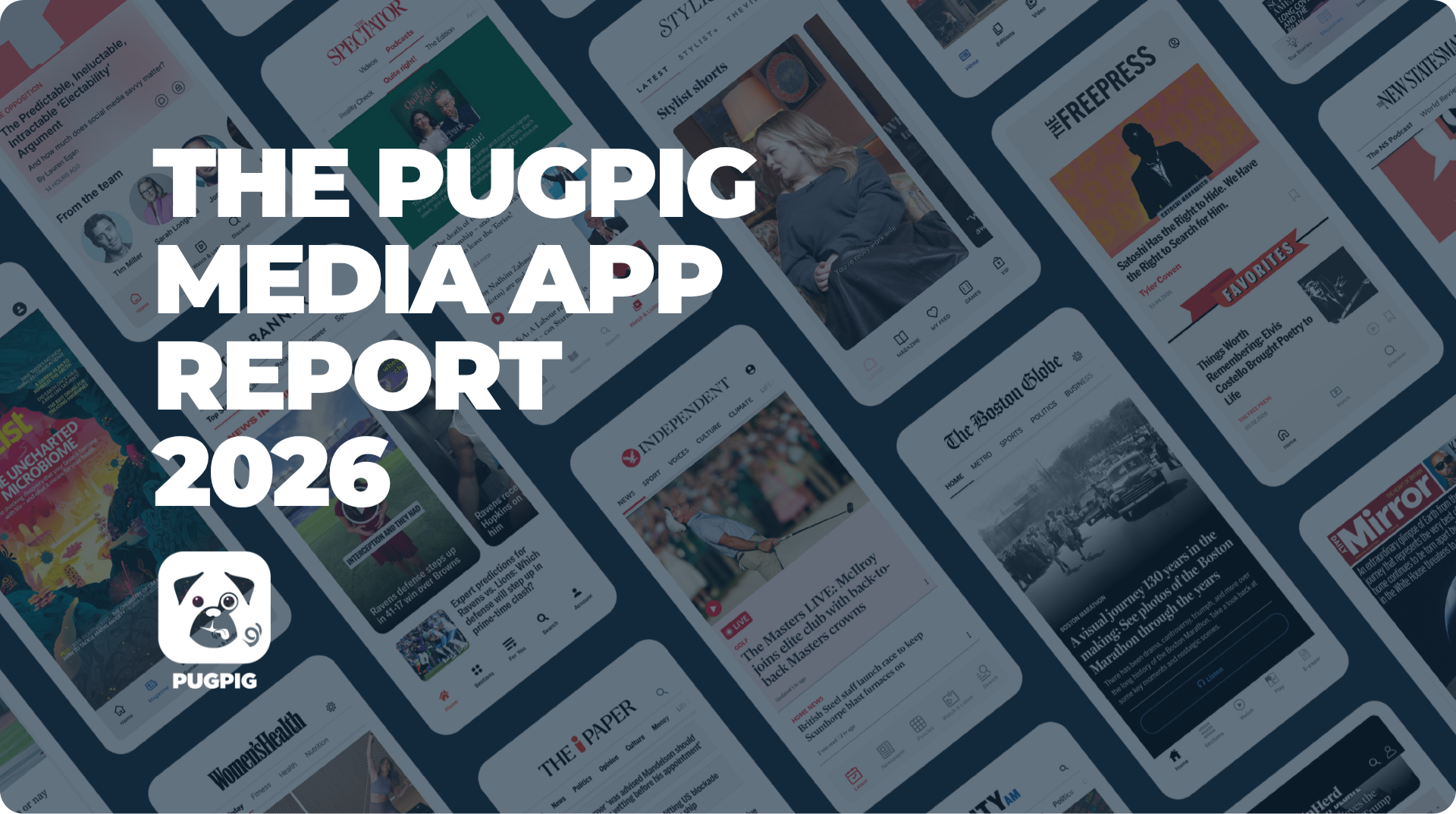
Two weeks ago we released our 2026 Pugpig Media App Report, at a pivotal moment for news media. Social platforms, influencers and AI chatbots are pulling attention away from traditional brands and apps are quietly becoming one of the few places where publishers still own the relationship end‑to‑end.
The report is built on benchmark data from more than 440 apps across 140 publishers, plus a survey of industry leaders across our network. It shows that engagement is rising and strategic confidence in apps high, but also reveals a large anonymous audience and a persistent measurement gap that are limiting how far publishers can go with product and revenue innovation.
In this edition of the Pugpig Media Bulletin, we’ll look at what those findings mean against the backdrop of these huge industry shifts and explore what publishers can do next to make their apps work harder to build habit, loyalty and commercial results. If you’re interested in reading the report in full, you can download it here.
Over the past few years, audiences have spent more time on social media, video platforms and messaging apps, while engagement with traditional news has steadily declined. The Reuters Institute’s 2026 Digital News Report highlighted how social and video have overtaken traditional channels as primary sources of news in many markets, especially for audiences under 35, with content creators stepping into roles once held by legacy publishers. At the same time, AI chatbots and aggregators are emerging as new gateways to information, raising concerns about lost referral traffic and control over how news is packaged for audiences.
In that environment, mobile alerts and apps have become some of the last truly direct relationships publishers have with their readers. At the start of the year, we highlighted Nieman Lab’s 2026 predictions, which argued that the future belongs to smaller, more resilient “ice cream shop” products built around owned distribution, stronger loyalty and niche offerings, rather than mass, factory-style output. Against that backdrop, our report aims to show how apps are performing and what sets the top performers apart from the rest.
The report draws on two complementary sources. First, we analysed performance data from more than 440 apps on the Pugpig platform, alongside a survey of publishers across our network exploring how they view their apps and the wider industry in 2026. The analytics provide a set of engagement benchmarks covering audience composition, time spent, visit patterns and feature adoption, while the survey captures publisher priorities, confidence, constraints and expectations around formats, paywalls and AI.
At headline level, the story is encouraging, with engagement across apps improving over the last year. This has been driven by a modest increase in sessions per user and screen views per session, but the clearest shift has been a significant rise in average session duration and total time spent per user per month. This has been driven by an increase in adoption of rich content features, such as audio, video and user-driven personalisation, all of which encourage users to spend more time in the app. Those users tend to visit more often, stay longer and explore more screens per session, contributing disproportionately to overall time spent.
This finding reinforces themes we see elsewhere too. It echoes the success of publishers like The New York Times in building daily habits around games, audio and vertical video. In the 2026 report, games consistently emerge as one of the clearest markers of committed usage, while audio listeners and video watchers also spend more time than text‑only readers, suggesting that these formats can act as habit engines even if adoption is still limited to subsets of the audience.
The report also underscores that what good looks like is not uniform across apps. Daily news, mobile‑plus‑edition and mobile‑first apps all show different engagement profiles and whilst replica-only products have become less central, curated editions still add real value, especially when combined with non-edition content.
Across the data set, almost half of app users don’t have a subscription and they behave very differently from paying users. As you’d expect, subscribers are dramatically more engaged, with higher session counts and time‑spent metrics, yet only a minority of publishers are actively optimising their apps to convert anonymous users into known readers or subscribers.
This mirrors a wider industry challenge. The Reuters Digital News Report described how many audiences come to news via social feeds and aggregators, often in “drive‑by” mode, with relatively low willingness to pay and high levels of news avoidance and mistrust. At the same time, those who do install and use a publisher’s app are often among the most engaged users, but if they remain anonymous, it is hard to connect their behaviour to subscriber growth, retention or lifetime value. The Media App Report makes a clear case that registration and onboarding flows, coupled with thoughtful paywall and conversion journeys, are some of the most underused levers in app strategy today.
There is also an opportunity for in‑app advertising. Apps are often designed as ad‑light experiences, which results in relatively low impressions per session, but high sessions per user per month mean the total impressions per user can still be meaningful when formats, measurement and sales strategies are tuned to app audiences. Treating the app as a revenue platform, across reader and advertising revenue, is one of the strongest commercial messages we have seen in the data.
The report’s data on traffic sources adds weight to the idea that apps are increasingly direct channels in a fragmented ecosystem. The vast majority of app sessions begin with users opening the app themselves, rather than arriving via push notifications, deep links from email or social or search. This deliberate usage sits in contrast to the algorithmic flows of platforms, where news is often incidental and squeezed between entertainment and creator content.
Our report also makes the case that more can be achieved by bringing users back into the app more frequently. We found that push opt‑in rates are reasonably healthy, but open rates can sometimes be low, indicating that there is real room to improve targeting, cadence, segmentation and creativity so that alerts become a valued habit rather than a source of fatigue.
The survey component of the report paints a nuanced picture of where publishers are in their app journeys. Most respondents describe their apps as mature and optimising, with priorities shifting toward product improvement, new formats and monetisation. Confidence in apps is broadly high and many publishers expect print to become secondary over time, with a third already digital‑only.
Yet the survey also highlighted a persistent measurement gap. Teams broadly agree that retention, engagement, subscriber growth and conversion of anonymous users all matter, but many still struggle to measure these outcomes consistently or to connect app behaviour to business metrics such as churn and lifetime value.
We also found that product team capacity is often the single biggest blocker to progress, rather than a lack of ideas or strategic clarity. In an environment where teams are juggling multiple priorities, it is easy for app optimisation to slip down the priority list, even as leadership expectations for direct audience performance rise.
Looking forward, (unsurprisingly) AI is set to play a much bigger role in apps over the next few years. The survey showed that publishers are most excited by its potential to improve personalisation, even though many have yet to integrate these capabilities into live products.
For publishers, the opportunity is to connect AI‑powered features directly to the engagement patterns highlighted in the app benchmarks. Personalisation of feeds can amplify the behaviours of super users and make it easier for readers to get to the content they care about quickly. Smarter discovery tools and daily digests tailored to user behaviour can also help by aligning the product more closely with how audiences navigate information in social feeds and chat apps.
In our conclusion within the report we distill the findings into a practical steps that publishers can take to make their apps work better for them:
In a media environment increasingly shaped by platforms and AI intermediaries, the publishers that make their apps more engaging, more measurable and more indispensable will be the ones best placed to turn direct relationships into lasting value.
Here are some of the stories that caught our eye in the world of news and publishing recently.
Newsletter
Newsletter
Newsletter

Newsletter
Newsletter