
Newsletter
Newsletter
For publishers rethinking audience growth, here’s what stood out from a full day of sessions at Arc XP Connect London.
26th June 2026
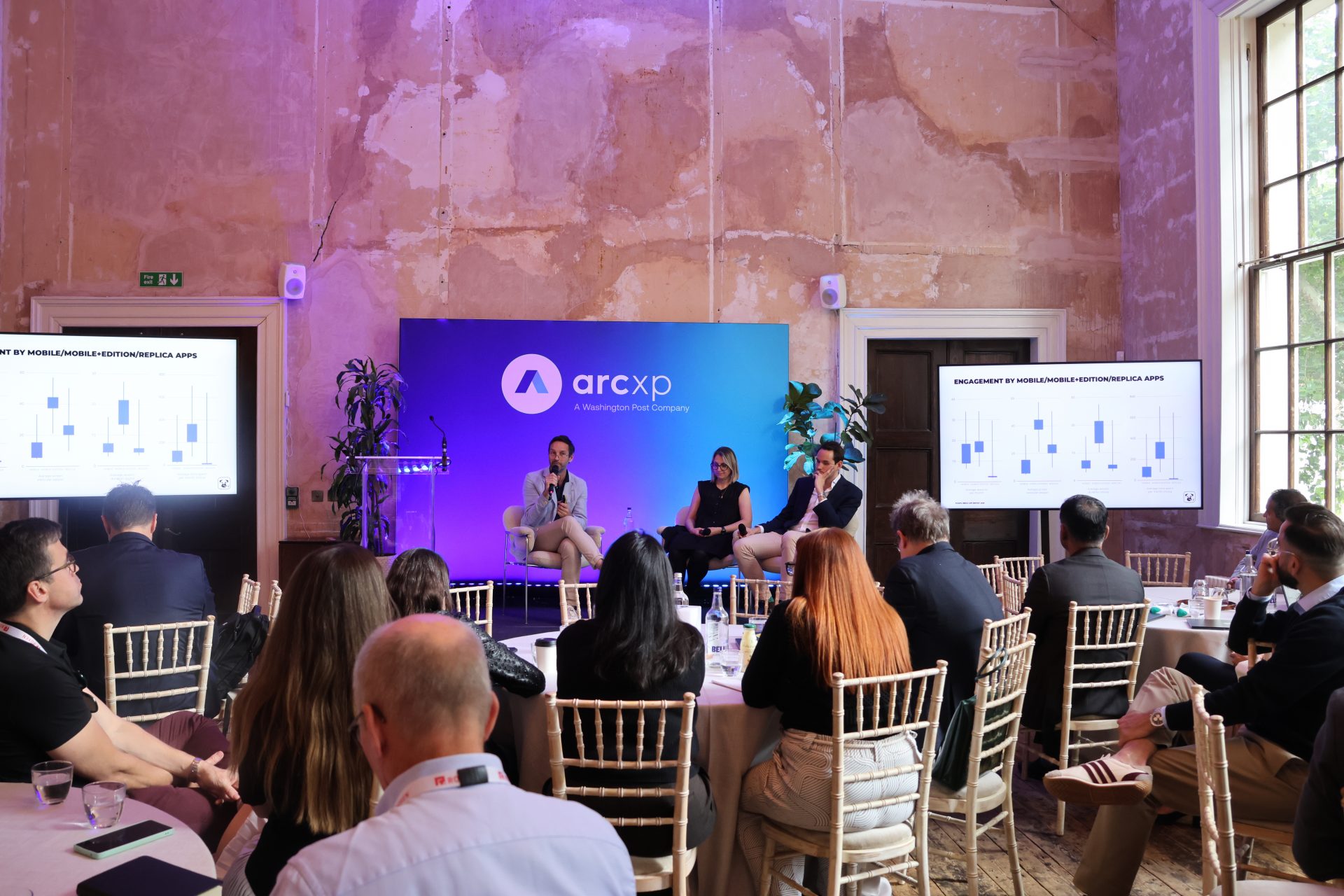
Platforms and search are going through another reset and the old playbook of chasing referral spikes is losing its power as AI answer engines and changing algorithms divert traffic away from publisher sites. The conversation at recent events has shifted toward something more fundamental. The focus is now on how to build durable audience relationships and products that can withstand whatever the next platform change looks like
A couple of weeks ago, Pugpig joined Arc XP Connect in London, where that shift was front and centre. In this week’s Pugpig Media Bulletin, we look at the key themes from the day and how publishers are responding. From FT Strategies’ push to prioritise first-party audience relationships, to Les Coops’ “Pay What You Can” subscription experiment, to the ways apps and new formats are quietly turning a small group of super users into the engine of sustainable growth.
At the event, the most consistent thread running through the day wasn’t a new one. Platform and search referral traffic, once the engine of audience growth, is no longer reliable. As FT Strategies Director Lisa MacLeod put it bluntly – 69% of news searches now end without a click. Answer engines are absorbing the query and returning the reader nothing. BuzzFeed (once the poster child of platform-native publishing) has filed for bankruptcy. The cautionary tale has become a case study.
Lisa’s response was that publishers need to rethink their acquisition models entirely. Rather than treating anonymous traffic as the top of a funnel, they need to get much better at turning unknown visitors into registered users, and registered users into loyal subscribers. “Publishers are unbelievably reluctant to ask people to register for content,” she said. “And I still don’t understand this.” The FT’s own numbers make the case with registered users being 7.4x more likely to subscribe, and active commenters are 46x more engaged than average readers. First-party audience relationships support advertising and subscriptions, but they also give publishers a much clearer understanding of who their readers are.
One of the clearest takeaways from Lisa’s talk was that publishers may need to think more radically about growth. Marc Gendron, Editor at Le Soleil and part of Quebec’s employee-owned cooperative Les Coops de l’information, shared a strong example of what that can look like in practice.
By March 2025, it was clear subscriber acquisition would miss annual targets, and the team needed to act before a planned price rise in early 2026. Their response was a five-week “Pay What You Can” subscription campaign designed to strengthen the value proposition and bring in new readers.
Importantly, the campaign did not happen in isolation. Before launch, Les Coops made a series of product changes to increase the value of subscribing and encourage registration. These included a daily poll for logged-in users, audio articles for mid-tier and premium subscribers, and cross-device bookmarking. They also tightened parts of the free offer by moving some content behind the paywall and limiting simultaneous access to four devices, which even prompted some groups sharing logins to move to corporate subscriptions.
The campaign ran across six news brands during the September and October 2025 municipal elections, when demand for local news was high. Framed around the message “your community, your price”, it positioned subscriptions as a way to support local journalism rather than simply buy access. That framing worked. The campaign delivered a 4.2% net increase in subscribers, beating its 3.5% target, and 84% of new subscribers had never subscribed before.
Another useful lesson came from pricing. When readers were given no suggested amount, the average payment was $3.12. A $5 suggestion lifted that to $3.39, and a $6 suggestion increased it again to $3.50. Rather than always choosing the lowest possible price, many readers were willing to pay more when given a clear anchor.
For publishers, the lesson is to experiment thoughtfully with product, pricing and positioning when growth starts to stall. Les Coops showed that lowering the barrier to entry, tightening the value of paid access and framing subscriptions around support and community can help drive both conversion and perceived value.
In a panel on how apps can help build loyal audiences, Pugpig CEO Jonny Kaldor was joined by Sebastian Giraud, COO of OQS Media (The Spectator, UnHerd) and Mariana Bettio, Head of Product at The Independent. The conversation opened with findings from our newly released 2026 Media App Report and focused on one of the primary patterns we’ve noticed, that engagement is highlight concentrated with around 10% of users account for 75% of all sessions, while roughly 5% account for 75% of screen views. This means that a relatively small group of highly engaged users is responsible for most of the value a publisher app creates.
Jonny dug into what sets those “super users” apart. The data showed that certain features are closely tied to deeper habits. Audio users do not necessarily read more articles, but they come back far more often, driving much higher total time spent over a month. Games generated extremely high levels of engagement, with usage far beyond that of text-only readers. And users who personalise their experience by following topics and writers visit apps almost twice as often as those who don’t. The pattern is that richer, more tailored experiences correlate strongly with stickier behaviour.
Sebastian and Mariana highlighted the practical implications of these findings. For The Spectator, as a weekly print publication, they need ways to stay present between issues and the app has become a critical mechanism for maintaining multiple touch points with subscribers. When the team chose to replace their generic thank-you page after subscribing with an app download CTA, engagement after 14 days rose by 80%, measured across both the site and the app. This serves as a reminder that small changes at key moments can have outsized impact.
Mariana described a similar focus at The Independent, applied differently. Unlike most news apps, users must register before accessing content. The assumption is that anyone who has gone to the effort of downloading the app has already shown interest, making it the right moment to ask them to sign up. Registered users can read five free articles a week whilst subscribers get the full app and daily edition. Each step deepens the relationship and sharpens the picture of who those readers are. Bulletin, their second app, takes a different tack again with condensed stories, AI-assisted summaries and personalised audio playlists built for people who may never use the main app at all.
Taken together, the data and case studies point that apps remain environments where a small group of highly engaged users can drive disproportionate value, if you give them the right reasons to come back. That means designing for habits by building features that invite repeat use, using registration and onboarding moments more deliberately and treating super users as the core.
The session closed with Jonny asking Sebastian and Mariana where they see readers engaging with news beyond apps. Sebastian’s answer landed as a useful frame for the whole conversation, “I see the app very much as your virtual coffee table. It’s what you would have had decades ago delivered to the house every morning. It’s your post, it’s your newspaper, it’s your magazine.”
For most publishers in the room, the shift away from platform and search referrals has already arrived. The industry has moved through the diagnosis stage.
What came through most clearly is that the publishers making progress are the ones who have stopped waiting for platform conditions to improve and started building direct relationships instead. The results from Les Coops, The Spectator and The Independent were a reminder of what’s possible when publishers actually act on what they already know.
Taken together, the ideas from Arc XP Connect suggest a simple but challenging shift. Instead of guessing what audiences want or what they will pay, publishers need to ask them directly and build products that respond to the answers. Whether it is inviting readers to set their own introductory price, asking them to register, or giving them tools to personalise their experience, the underlying move is the same. Publishers should treat audiences as participants in the relationship rather than passive traffic. The publishers sharing results on stage were not waiting for platforms or search to stabilise, they were testing offers, nudging habits and using the data from those experiments to refine how they serve, retain and charge their most engaged users
Here are some of the stories that caught our eye in the world of news and publishing recently.
Newsletter

Newsletter

Newsletter

Newsletter

Newsletter