
Newsletter
Newsletter
The recurring relationship is the core strategic asset in media and publishing, and the app is the best place to nurture it.
2nd September 2026
This week’s bulletin features a guest contribution from Mads Holmen of MonetizationOS, a company that builds paywall and entitlement infrastructure for publishers. Mads argues that publishers should stop treating subscriptions, advertising and commerce as separate outcomes, and instead see them as different expressions of one ongoing customer relationship.
It is a timely argument, supported by industry examples including INMA’s reporting on Clarín, where a very small proportion of subscribed users reportedly generate a disproportionate share of combined subscription and advertising revenue. Drawing on this and other examples, alongside Pugpig’s own app data, Mads makes a practical case for using apps to deepen customer relationships through identity, habit and repeated value, rather than simply monetising a reader once.
In a world where LLMs promise to research, think and write for us, be our friend and therapist, and soon put us all out of work, I think we’re due for a good chat about relationships. The ones that matter.
Let’s start our journey together in Buenos Aires. The data team at Clarín did something few publishers have ever attempted in earnest; they attributed all of their revenue to individual readers. They created one ledger per person, with subscriptions and advertising side by side. The result, presented by Greg Piechota at INMA’s Subscriptions Town Hall in December 2025, is that 1% of Clarín’s users generate 72% of total revenue.
Piechota calls it the hidden link. People most likely to pay a publisher directly are also the audience advertisers most want to reach. They are also much more likely to stay around and drive lifetime value. In short they are the kind of relationships worth cultivating. Corporate finance frameworks like “The Customer Base Audit” and other CBCV (Customer-Based Corporate Valuation) approaches have convincingly demonstrated that most consumer businesses hide outsized numbers like these, whether they know it or not.
If value concentrates this heavily in core customer relationships, it is striking that publishing companies’ P&Ls, bonus plans, or strategies, are so rarely denominated in lifetime terms. One reason is probably the many immediate pressures facing publishing and media companies from aggregation and disintermediation. The industry is being “squeezed” between creators, social platforms and aggregators that divert casual audiences, chatbots and AI search that disintermediates referrals, and AI-generated content that floods the Web (all of which still, individually, needs better regulation).
Nonetheless, the path forward is to continue to invert and invest in the core relationship with customers. As John Slade, the FT’s CEO has put it, “It’s that direct relationship which drives all aspects — or certainly the vast majority — of our business model”.
The only viable strategic alternative is to bet on AI licensing, content marketplaces and plan to flourish as a content factory feeding the beast. Some companies will likely succeed in this model, but they will look as different from today’s publishers as dark kitchens do to old fashioned restaurants. And what the agents really want is the valuable content and data with high authority, so there is still a fundamentally unresolved paradox looming over that route.
Businesses that orient measurement, organizational structure, product and incentives around developing, sustaining and nurturing the recurring relationship with customers acquire an advantage. They have the ability to price any single revenue stream attractively, while recapturing that value elsewhere, over time. They set themselves up for a lifetime of value.
A subscription makes the relationship contractual by giving you the ability to charge the consumer directly. Advertising can monetise the recurring attention the relationship generates. Commerce can monetise the recurring decisions it earns the right to influence. Data can monetise the behavioural record the relationship produces (e.g. via bundling).
The best operators already work this way. The New York Times has significantly grown its digital advertising on the attention its bundles have created and its games bring members back every day. Revolut and Robinhood now run +10 product lines above 100m in revenue each, based around one core account relationship. Increasingly they are codifying banks and financial apps as lifetime membership organizations, built around a subscription that offers benefits, deals and advantages.
And, as Pugpig’s own 2026 Media App Report dived much deeper into, increasingly this recurring relationship lives and thrives in the app. Yet, despite clear evidence that apps are the best place to cultivate a valuable long term relationship, and that richer experiences drive deeper and more frequent engagement, The Media App Report also made a compelling case that registration and onboarding flows, coupled with thoughtful paywall and conversion journeys, are some of the most underused growth levers today.
Flywheels are simplified versions of the world which, due to their abstract nature, can help us effectively rise above the noise and observe the signal. Here’s my little relationship machine in plain english. Deliver value and give a person more reasons to return. Make them return often enough (ideally in an app that lives on people’s phone so their brain automatically opens it when they have 5 mins to spare) and a real habit forms. A habit deepens into a real relationship, and a relationship earns the right to expand the scope and offer new services.
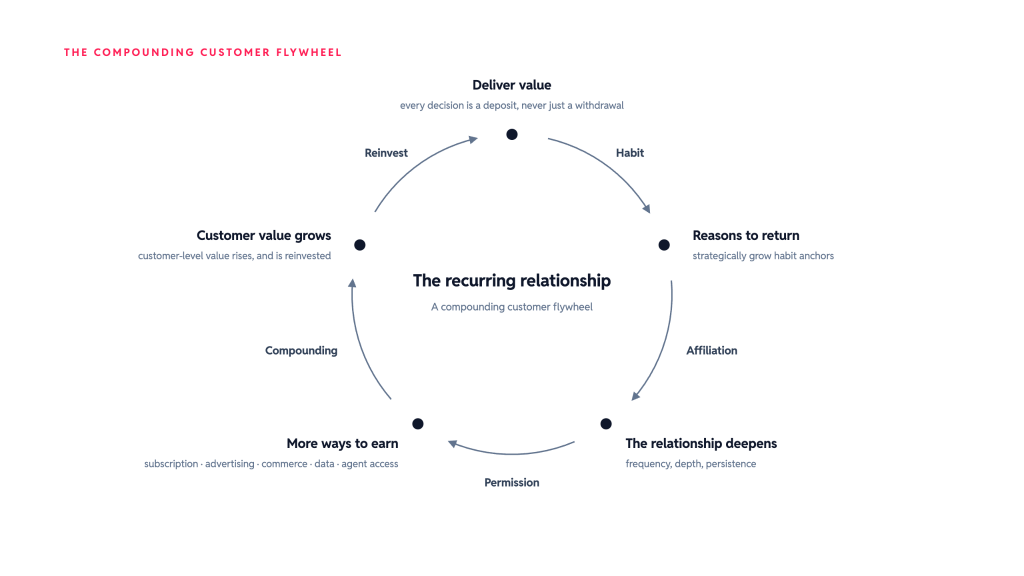
Gradually each new layer adds value in its own right, and, crucially, adds yet another reason to return or deepen the relationship. The wheel goes round, the business grows and prospers, and every revenue stream, subscription, attention, commerce and bundles, draws on the same spinning asset: the frequency, depth and persistence of one person’s return. Deepen it and they can continue to compound. The only word of caution here is that this approach can ultimately lead to clutter, feature sprawl and ultimately enshittification.
Nonetheless, evidence says the relationship wheel really does spin once it gets going. Piechota’s comparison of The New York Times and Norway’s Amedia, found all-access bundle subscribers show up to 26 times the average lifetime value of single-product customers, with engaged bundle subscribers churning at around 0.7% a month. The reward in this case is dramatically lower churn and more prime attention to also sell in the form of advertising, rather than a much higher price.
The app is the modern flywheel’s core growth engine. The vast majority of app sessions begin with the reader opening the app themselves, with nothing pushing them there. In an app, a bundle of rich features and five products feels like one compounding relationship, ready to deliver value to me as a consumer, without friction.
One key challenge is that the audience needs and desires evolve over time. Publishing and media need to speak to people in the right moment, which can be as trivial as sending the daily newsletter or deciding whether to push a notification to a subscriber. But another is when a known reader arrives in the app or on the web, and the business has a split second in which to decide: which message, which package, which price, for this person, right now. Shall we hold off, attempt to register them, or gate them fully? Very few companies I speak to feel they have nailed intelligent decisioning and omnichannel orchestration, despite the tech industry making bold promises for more than a decade. Many still have no idea how such decisions impact lifetime value.
INMA’s retention review notes that the most sophisticated publishers now use decisioning tools that align paywalls, engagement and retention rather than running them as separate departments, citing Hearst’s approach. Whoever learns to make these “small” relationship decisions well, thousands or millions of times a day, stops turning the flywheel by accident and starts turning it on purpose.
While this piece might feel big and strategic, it doesn’t need a transformation programme to get started with relationship driven strategy.
Here are some of the stories that caught our eye in the world of news and publishing recently.
Newsletter
Newsletter

Newsletter

Newsletter