
Newsletter
Newsletter
From World Cup games and live blogs to daily podcasts and morning news, WAN-IFRA’s Digital Media Europe showed that sustainable growth comes from giving audiences a reason to return rather than simply giving them more to consume.
29th October 2026
Last week, Pugpig attended WAN-IFRA’s Digital Media Europe in London, where audience, product and revenue leaders shared strategies spanning subscriptions, advertising, audio, AI and revenue diversification.
The examples were varied, but one theme connected several of the sessions. Big events, distinctive journalism and new formats can bring audiences through the door, but attention alone is not enough. The publishers making the most of those opportunities were using apps, games, podcasts, live coverage and carefully designed product journeys to give people a reason to come back.
In this week’s Media Bulletin, we look at what The Guardian, The Athletic and Bloomberg can teach publishers about turning moments of attention into lasting audience habits.
Few events generate attention quite like a World Cup. For publishers, that creates a rare opportunity to reach audiences at enormous scale. It also creates intense competition from broadcasters, platforms, creators, sports specialists and countless other outlets covering the same matches.
Both The Guardian and The Athletic used the tournament to grow their audiences, but neither treated the initial spike in interest as the end goal.
For The Guardian, that meant rethinking their usual reader-revenue pitch. The publisher has spent a decade asking readers to support independent journalism that, on the website, is free and open to all. It is a powerful proposition that has helped build a base of 1.4 million supporters and increase digital reader revenue to around 45% of turnover.
However, The Guardian found that those arguments did not resonate as strongly with World Cup audiences, so they changed their message. Rather than lead with the importance of funding a free press, the World Cup campaign placed the coverage itself at the centre of the proposition with the promise of “every moment, every match”.
That might sound like a relatively small change in marketing copy, but it reflected an important strategic shift. The Guardian was matching its proposition to the audience’s immediate motivation rather than assuming that one message would work equally well for every reader.
The immediate call to action was also not to contribute or subscribe. It was to download the app or listen to the Football Weekly podcast. The aim was to create a repeat relationship first and give the commercial relationship time to develop.
The campaign helped Football Weekly top the sports podcast charts for 17 days, while listening roughly doubled and app downloads rose well above normal. The Guardian also ran a follow-up campaign around the start of the Premier League season, attempting to stop those new users from falling back into their old habits once the World Cup was over.
The Guardian described its app as the “strongest expression of itself because it drives discovery across verticals and rewards habit”. It helps people move beyond the story or subject that first attracted them. Onboarding introduces users to notifications and newsletters, My Guardian provides a curated feed, and puzzles and games create additional reasons to return. For the World Cup, they also added a daily football game.
The app helped The Guardian turn a burst of football interest into discovery, personalisation and habit. The Athletic took a similar approach, making their World Cup journalism free to access while using its specialist reporting, app and interactive products to build deeper relationships with fans.
The scale of the editorial effort was significant. The Athletic deployed 70 reporters across the US, Canada and Mexico, covered every match with a fully editorial live blog and produced six of their ten most-read stories during the tournament. Their live blogs alone generated 22% of total page views over the period.
This also resulted in 50 million free-content exposures across New York Times surfaces, and once users arrived, the app became a core focus. The campaign generated five-figure app downloads, approximately 50,000 additional weekly active users and a 9% uplift in app daily active users during the tournament.
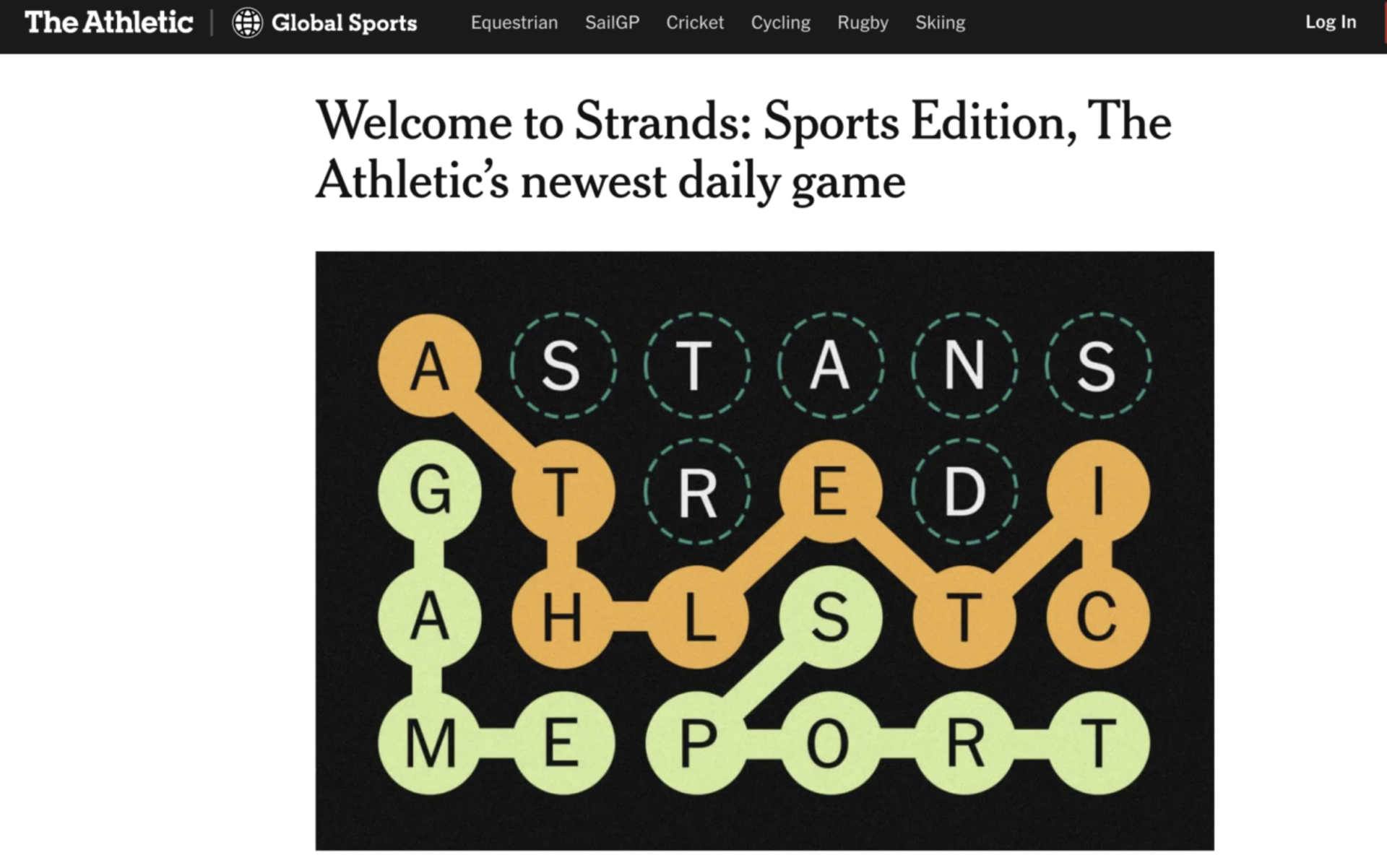
Games were used to give those users a reason to return. The Athletic’s Pick ’em game asked fans to predict results, compete with friends and test themselves against newsroom experts. It produced 2.2 million predictions from 335,000 users, while 58% returned to the World Cup hub.
The journalism attracted readers, while the product gave them reasons to return. A reader might arrive to follow a match or read an expert analysis, then come back to maintain a prediction streak, check a ranking or follow a live blog.
Apps are particularly well suited to building these loops. Notifications can bring users back at the right moment, personalised feeds can introduce adjacent coverage, and mobile features can make games, audio and live content easier to fit into daily routines. Instead of asking users to remember to return to a website, the app earns a recurring place on their phone.
Habit also featured in Bloomberg Media’s advertising strategy, although from a different commercial perspective. Bloomberg has operated radio since the early 1990s, but its sales team no longer frames the proposition primarily around the station. Instead, it sells advertisers “the morning”, the period when Bloomberg’s journalists are preparing decision-makers for the day ahead.
That reframing focuses effort on the audience need and commercial moment Bloomberg can own. Radio, podcasts, video and journalism can all contribute to that proposition.
The company’s results suggest that greater focus can outperform greater complexity. European advertising revenue grew 11% in 2025 without an increase in the size of the commercial team. Audio advertising grew 16% and podcast advertising 36%, while Bloomberg reported around 85% client retention in Europe.
Bloomberg also acknowledged that it had created too many first-party audience segments after introducing its paywall. The available advertising inventory became spread too thinly, reducing its value, so the company is now simplifying the product and concentrating on the audiences and sectors where it has the clearest advantage.
This extends the lesson from The Guardian and The Athletic into advertising. A clear understanding of the recurring audience need or moment the brand is best placed to serve can guide both product development and the commercial proposition, helping teams focus on the formats, audiences and sectors where they offer the greatest value.
The examples shared at Digital Media Europe offer publishers a practical starting point for building lasting audience relationships.
Start with what brings people in. This could be a big event like a World Cup, an election, a breaking story or even a daily need to understand the markets.
Then give them a natural next step, this might be following a topic, switching on notifications, making a prediction, registering, saving an article or listening to a podcast.
Give them a reason to come back. Games can build competition and streaks, podcasts offer familiar hosts and a regular listening routine, live blogs keep people up to date, and personalised feeds help them discover more relevant coverage.
Track what happens once the initial interest fades. Alongside peak traffic, downloads and registrations, measure active days, return frequency, notification and newsletter adoption, movement between formats, conversion and retention. These reveal whether a moment of attention is developing into a lasting relationship.
The product should make that journey feel coherent. The audience may first encounter a publisher on social media, Reddit, WhatsApp, search or an AI interface, but owned products, particularly apps, give publishers more control over what happens next. They provide the tools to recognise users, learn their preferences, introduce other parts of the portfolio and build a direct relationship that does not disappear when an algorithm changes.
This may become even more important as publishers adapt journalism for AI agents. Machine-readable structures can make reporting easier for assistants to find, interpret and use, but they will not on their own create the human habits that underpin subscriptions, membership and valuable advertising audiences.
Digital Media Europe demonstrated that large audiences are still available to publishers that meet the moment. The harder task is turning that attention into something durable.
The publishers making progress are not relying on the content alone. They are building an experience around it. An app that becomes a destination, a game that creates a return loop, a podcast that earns a place in the day or a proposition that owns a valuable moment.
Lasting value comes from giving people a reason to return long after the initial interest has passed.
Here are some of the stories that caught our eye in the world of news and publishing recently.
Newsletter

Newsletter

Newsletter

Newsletter